
By Caitlyn Tiedje
SW Junior High Math, Science, and Intro to Computational Thinking
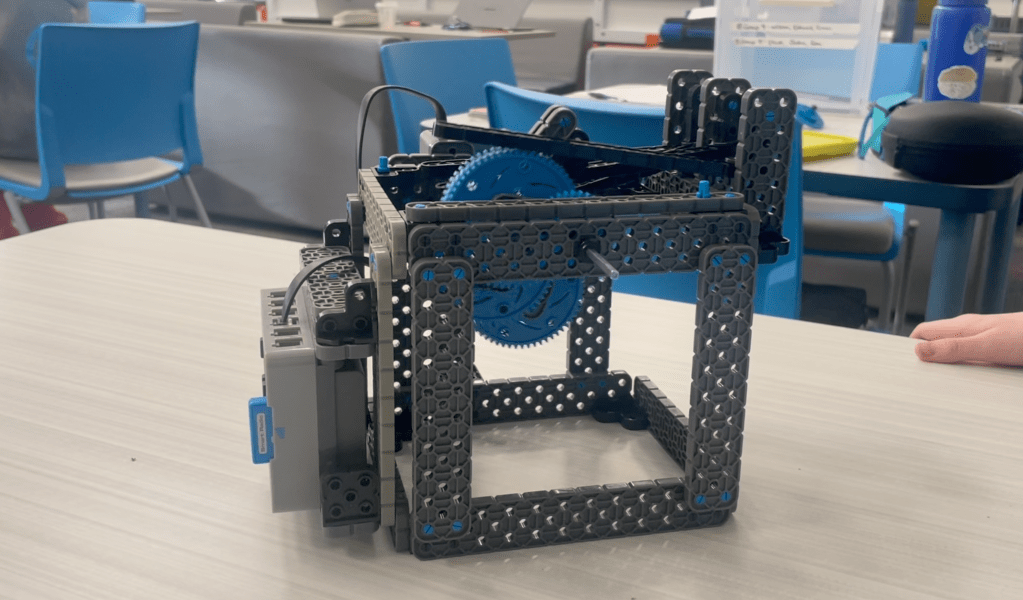
Students are wrapping up their final design challenge in our Grade 7 Introduction to Computational Thinking course at the South Junior High Campus. This project aligns with Alberta’s CTF / CTS competencies, with a focus on problem solving, design thinking, and the application of technology to model real-world systems. Using VEX IQ robotics kits, students were challenged to design and build a mechanism that produces a clear, repeatable motion inspired by the natural world, such as animals, insects, plants, or natural phenomena.
Students followed our Design Process to arrive at their final kinetic sculptures. During the Explore phase, students researched three different natural motions and analyzed short video clips to answer the following questions:
- What parts are moving?
- In what direction do they move?
- How would you describe the motion? Is it smooth, jerky, slow, or cyclical?
Each motion was then sketched across several frames, showing the beginning, middle, and end positions, and annotated with arrows and notes to highlight movement and mechanics.
In the Create and Solve phase, students selected components from the VEX IQ parts bins and began building and testing prototypes to replicate their chosen motion. Designs were inspired by a wide range of sources, including human movement, waves, fish, trees, animals, and more.
Students showcased their final products in class and reflected on both their designs and their learning process through entries in their engineering journals.
Next steps: In the coming term, we aim to expand the available mechanical components—such as rack gears, worm gears, screw lifts, and conveyor systems—to further support student creativity and deepen learning around mechanical advantage, complex systems, and iterative design, strengthening alignment with Alberta’s CTF/CTS outcomes.
This blog post was enhanced with ChatGPT using the prompt, “clean up this blog post for clarity, grammar and flow.”
 STEMIA Journal