
By Connor Butler
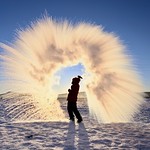
During the recent cold snap, January 10-12 2024, some of our grade 8 students ventured outside with hot water to see what happens when you throw it into the cold air. The water transformed into a white cloud before hitting the ground. But why?
The Science of Hot Water Clouds:
When hot water is thrown into freezing air, the display is a result of rapid condensation and the principles of thermodynamics. As the hot water meets the frigid air, it loses heat energy to the surroundings. The molecules in the hot water slow down, causing the water to cool rapidly.
Condensation kicks in as the temperature difference between the hot water and the cold air becomes significant. The air near the hot water is saturated with water vapor, and as it cools, the vapor condenses into tiny water droplets. These droplets become visible as a cloud, creating the illusion that the hot water has transformed into steam.
Why Doesn’t the Water Freeze?
Interestingly, the water doesn’t freeze instantly despite being exposed to freezing temperatures. The rapid cooling and subsequent condensation prevent the water from solidifying into ice. Instead, the energy released during condensation keeps the water in a liquid state, creating the beautiful cloud effect.
We hope that we don’t have another opportunity to try this again too soon, but when the weather gives you a polar vortex you might as well make clouds.
Feature Image by qwer5566 on https://www.flickr.com/photos/12105740@N08/40072296043



 STEMIA Journal